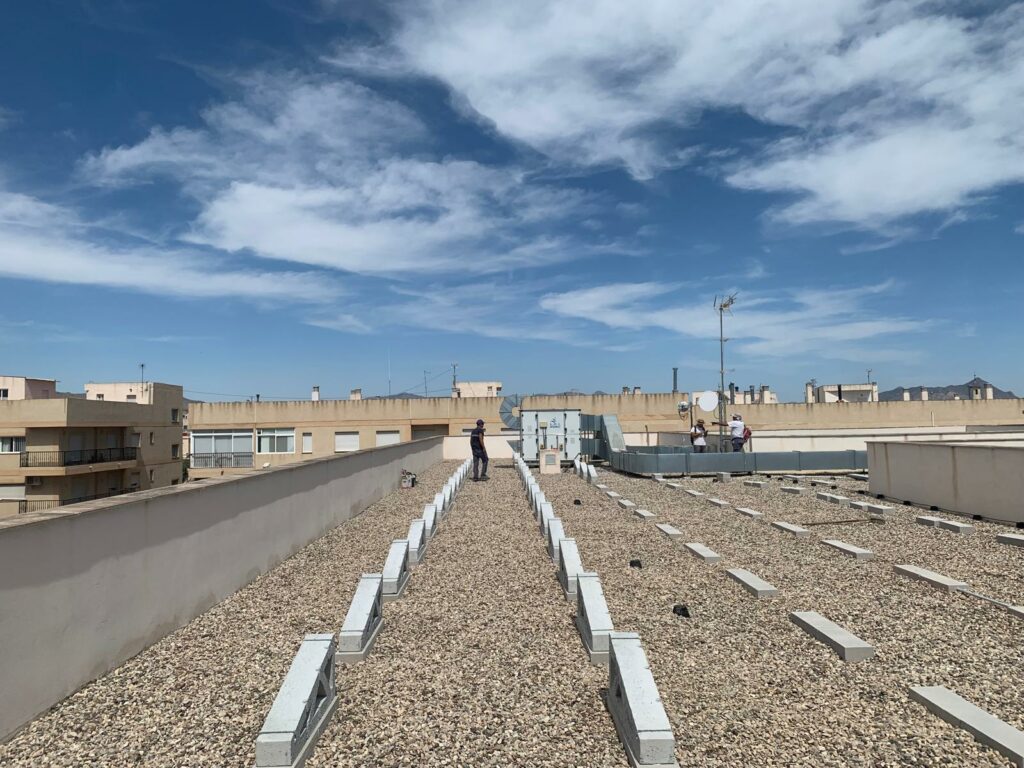
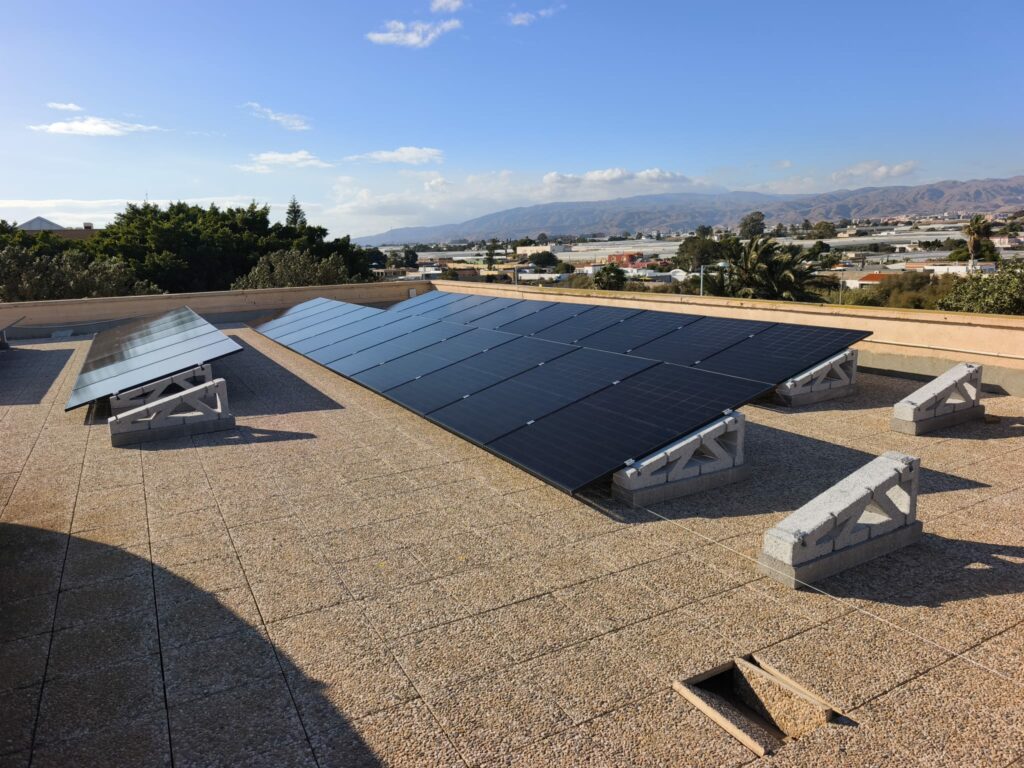
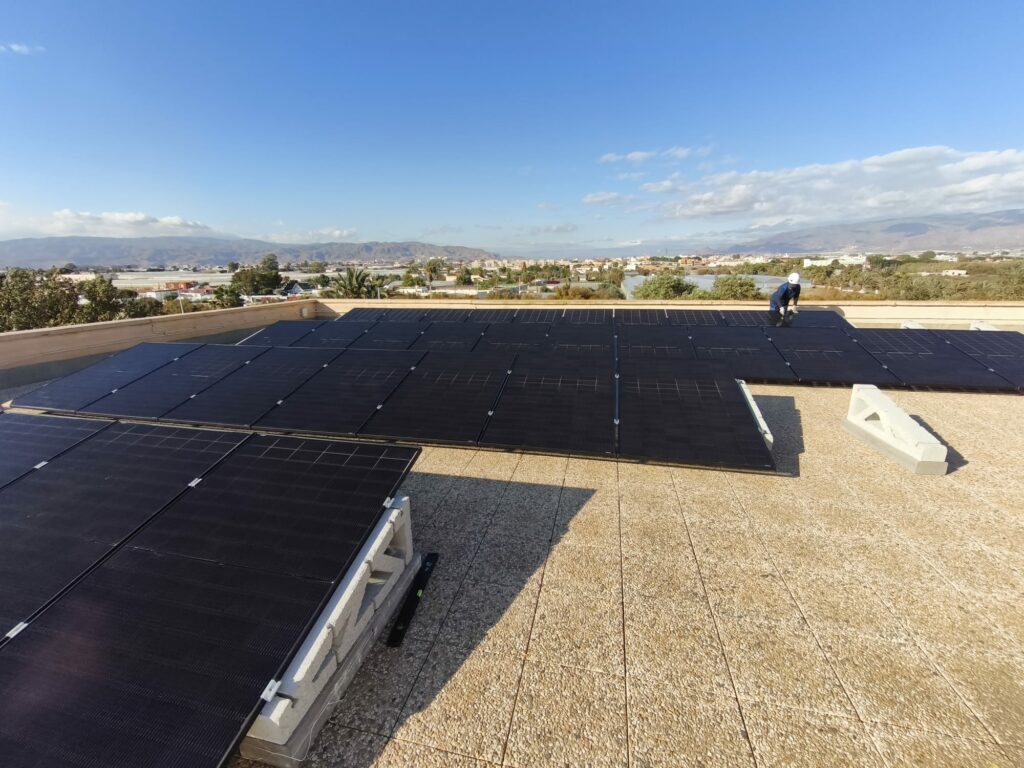
In this installation at the University of Almeria, a solution with precast concrete supports for solar panels on flat roofs was chosen, using a ballasted system without perforation.
The installation combines horizontal configurations with optimized inclinations (approx. 10º-15º), ideal for technical roofs where the aim is to maximize energy production without compromising the building structure.
This system allows a fast, safe and efficient installation, adapting perfectly to large roofs with technical obstacles such as skylights, air conditioning machinery or architectural volumes.




Technical data sheet of the installation
- 📍 Location: University of Almería
- 🏠 Type of roof: Technical flat roof
- 📐 S upport model: Concrete support with an inclination of approximately 10º-15º in horizontal configuration.
- 🧱 Fastening system: Ballasted system (without drilling)
- 🧩 Ballast used: Ballast integrated in the concrete support itself .
- 👷 Installation performed by: Specialized installation company
Concrete supports for flat roof installations
In this installation, concrete supports specifically designed for flat roofs have been used, allowing the installation of solar panels without the need for mechanical anchors.
As shown in the images, the panels are arranged in aligned rows on compact concrete structures, optimizing the available space and facilitating roof distribution.
This type of support acts simultaneously as structure and ballast, eliminating the need for additional metallic systems.
Among its advantages are the following:
- Installation without drilling holes in the roof
- Waterproofing protection
- Reduced assembly times
- Increased wind stability
- Virtually no maintenance
Ballasted system without drilling
The system used in this installation is based on concrete supports that provide their own weight as a fastening element, avoiding perforations in the roof.
This type of solution is especially important in buildings such as the University of Almeria, where the integrity of the roof is a critical factor.
The concrete supports are designed to offer high structural stability due to their weight and geometry, and can even be supplemented with additional ballast if necessary.
This system is ideal when:
- The cover cannot be drilled
- The aim is to avoid leaks or structural damage
- Fast and clean installation is required
- Reversible or demountable solution needed
Optimized distribution on the technical roof
One of the most outstanding aspects of this installation is the adaptation to the environment of the roof, where there are multiple technical elements such as:
- Skylights
- Air conditioning equipment
- Architectural volumes
- Passage and maintenance areas
The concrete supports allow great flexibility in the distribution, facilitating the layout of the installation around these elements without the need for structural modifications.
This allows:
- Making the best use of the available surface
- Maintain technical access
- Avoid shadows between modules
- Optimize solar orientation
Photovoltaic installations in public and university buildings
Installations with concrete supports in buildings such as the University of Almeria are becoming more and more frequent, as they allow the implementation of sustainable solutions without affecting the existing structure.
The use of ballasted systems in this type of projects allows:
- Speed of execution
- Structural safety
- Adaptation to complex roofs
- Reduction of construction costs
- Easy maintenance
Precast concrete supports have become a key solution for photovoltaic installations in educational, industrial and administrative environments.
Supports used in this installation
In this installation in Murcia, the following have been used:
👉 Concrete support 15º horizontal
If you want to know the complete technical characteristics of the 15º bracket or its compatible accessories: